A neon sign moves through six real stages from a paper pattern to a lit, mounted sign. The list below is the same six stages every piece in our portfolio goes through.
-
01
Pattern & layout
The design is drawn full-size on paper or board — the pattern the glass bender will follow tube by tube — and the letterforms or artwork are planned as a run of separate tube sections that can each be bent, filled, and later wired together into one continuous circuit.
-
02
Glass bending
Straight glass tubing is heated over a gas-fired ribbon burner or a hand torch until it softens enough to shape — real soft (lead/soda-lime) neon tubing works at roughly 1,200°F (650°C) — while the bender gently blows through a rubber hose at the open end to keep the bore from collapsing as each curve, corner, and letterform is bent freehand against the paper pattern beneath the bench.
-
03
Electrode attachment
Once a section is fully bent to pattern, a metal electrode is heated and fused onto each cut end of the tube, and a small side tube (the tubulation) is added — this is the port the tube will later be evacuated and filled through, and it gets sealed off for good as the very last step.
-
04
Bombarding (outgassing)
The sealed tube is connected to a vacuum pump and evacuated, then a brief high-current charge — several hundred milliamps — is run through it to heat the glass to roughly 420°F (216°C) and the electrodes to roughly 1,400°F (760°C), driving off trapped gas and moisture that would otherwise poison the fill and shorten the tube's life.
-
05
Gas filling & sealing
After the tube cools, the real fill gas — pure neon, or argon with a droplet of mercury — is admitted at a real low pressure that scales with tube diameter (roughly 6mm Hg for the thinnest 9mm tube up to about 15mm Hg for a wide 25mm tube, per standard luminous-tube reference charts), and the tubulation is torch-sealed shut, permanently trapping the fill inside.
-
06
Aging, testing & mounting
A freshly filled tube is run in on slightly elevated current to stabilize its glow — neon settles in roughly 15 minutes, while an argon/mercury fill can take several hours to reach its full, even brightness — before the finished sections are mounted to a backing, wired together with GTO high-voltage lead wire, and connected to a correctly sized transformer.
Why it has to be glass, not a printed film
A real neon tube is a sealed glass vessel with two electrodes and an ionized gas inside it — the light itself is the gas glowing under high voltage, the same basic physics as a fluorescent tube or a plasma globe, not a light source shining through a diffuser. That’s the entire reason a hand-bent glass letterform has a warmth, an unevenness, and a genuine glow that a flat LED strip printed to look like a tube can approximate in photos but never actually reproduce in person.
Neon gas vs. argon and mercury
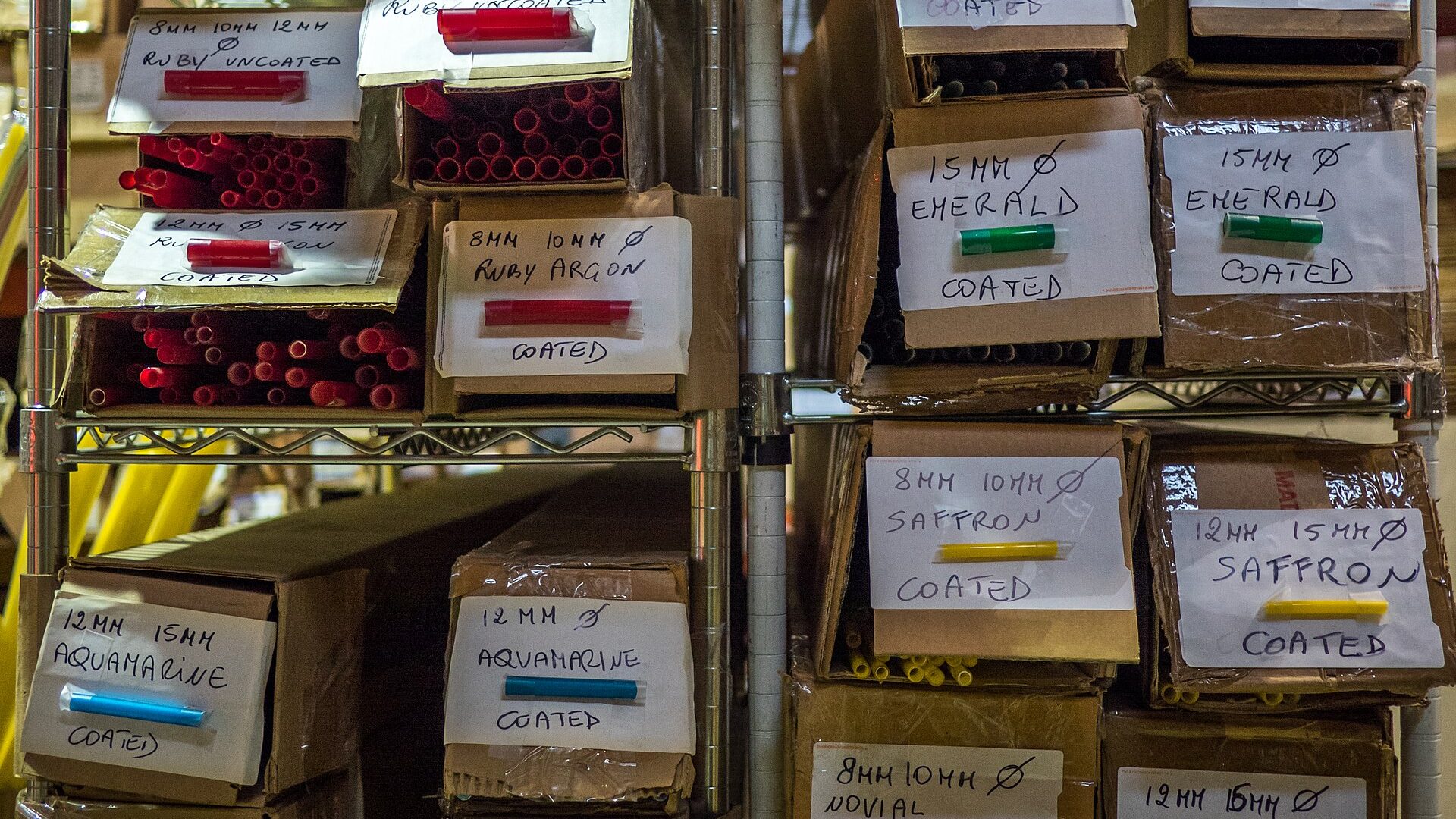
Every neon color in the world starts from one of exactly two base fills: pure neon gas, which glows its own real red-orange with nothing else added, or argon gas with a droplet of mercury, which on its own glows a pale blue-violet — but whose invisible ultraviolet output is what makes every other color possible, by exciting a phosphor coating painted inside the glass or by passing through colored glass tubing. See our full gas & color reference chart below for the real combinations.